Human teleoperators spend substantial time demonstrating behaviors that robots can already perform autonomously, limiting the scalability of data collection for robot foundation models. Task and motion planning (TAMP) can automate many of these behaviors, but a fixed planning domain may not support every stage of a long-horizon manipulation task.
We present TANDEM (Tamp with As-Needed Demonstrations for Efficient Model fine-tuning), a system that combines TAMP with selective human teleoperation to collect demonstrations for tasks beyond the planner's capabilities. Our key idea is to represent human assistance as an on-demand planning capability. Given a language instruction and visual observation, TANDEM uses pretrained vision-language models to extend the planning domain with missing predicates and human-executed magic operators. This allows the planner to interleave autonomous and human-executed stages without task-specific intervention points. After each human stage, TANDEM re-perceives the scene and checks whether the intended effects hold before resuming autonomous planning. To support fine-tuning vision-language-action (VLA) models, TANDEM also uses example pretraining trajectories to align planner-generated motions with the target model's pretraining distribution.
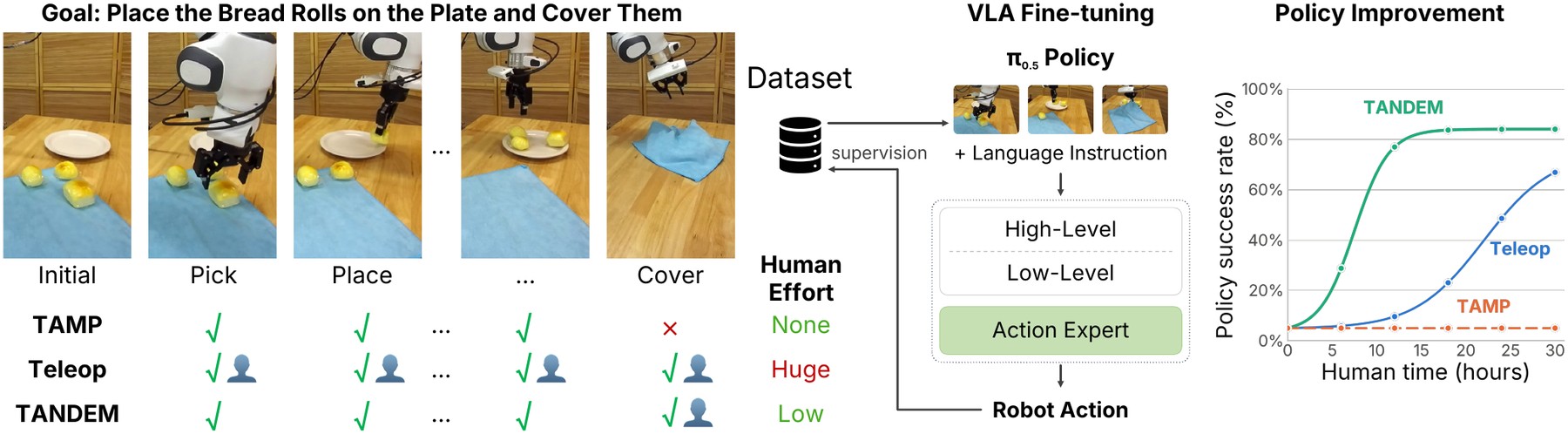
We evaluate TANDEM on five long-horizon manipulation tasks beyond the TAMP domain's capabilities. On a representative long-horizon task, TANDEM collects 2.9× as many demonstrations as full-task teleoperation at the same human intervention time. Fine-tuning a pretrained π0.5-DROID model on 20 TANDEM demonstrations per task increases average task success from 0% to 60% across the five tasks.
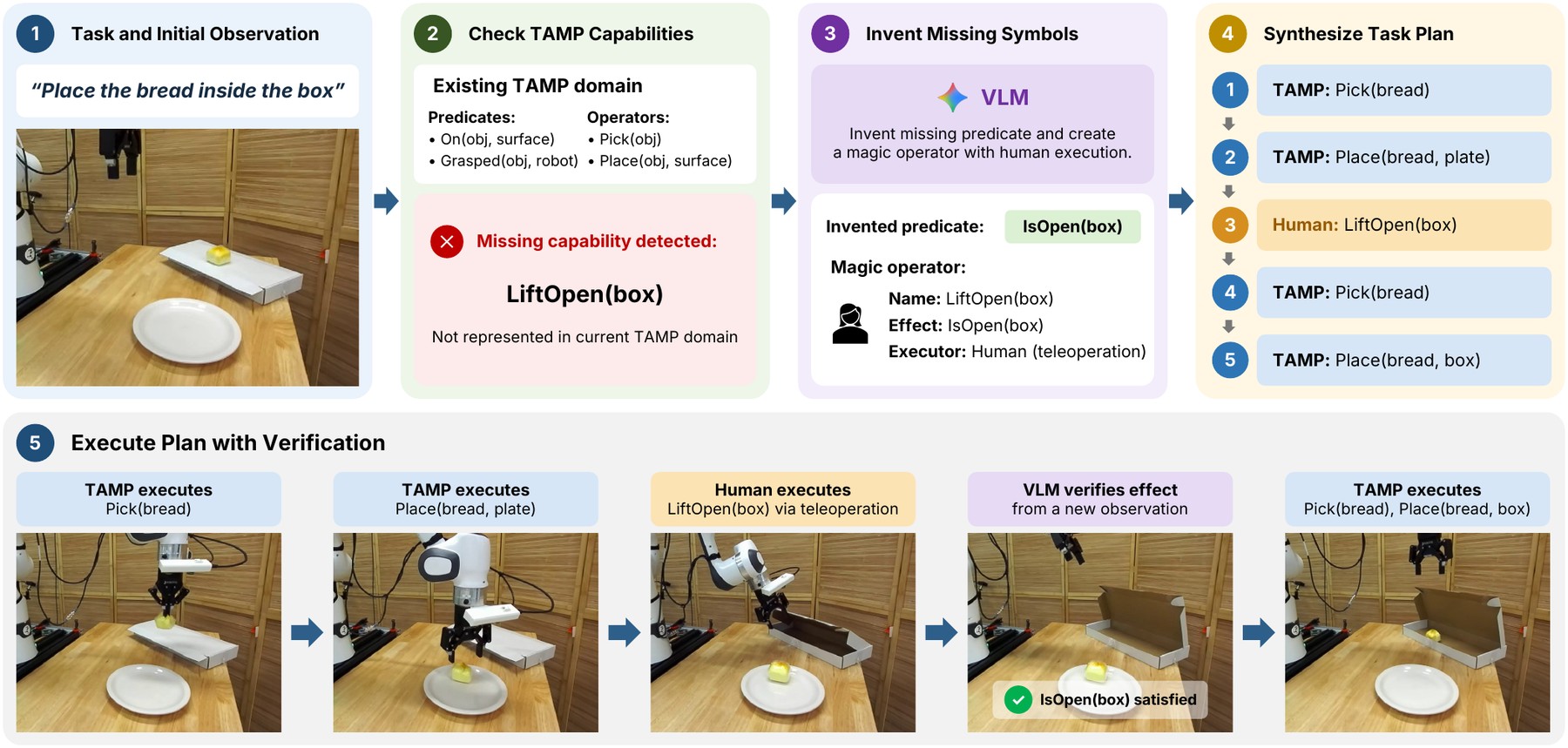
A VLM extends the TAMP domain with missing predicates and human-executed magic operators, so one plan can interleave autonomous and teleoperated phases.
A VLM invents predicates the domain is missing, each with a natural-language definition, e.g. IsOpen(x): “x is open”. The definition also lets a VLM check the predicate from an image.
Operators executed by a human through teleoperation. They have the same symbolic structure as TAMP operators, e.g. LiftOpen(box) with effect IsOpen(box), so the planner can use them.
Robot phases run on TAMP and human phases go to teleoperation. After each human phase, TANDEM re-perceives the scene and verifies the effects before planning resumes.
All phases of a successful trial form one complete demonstration. DATAFARM aligns the TAMP segments with the VLA’s pretraining data.
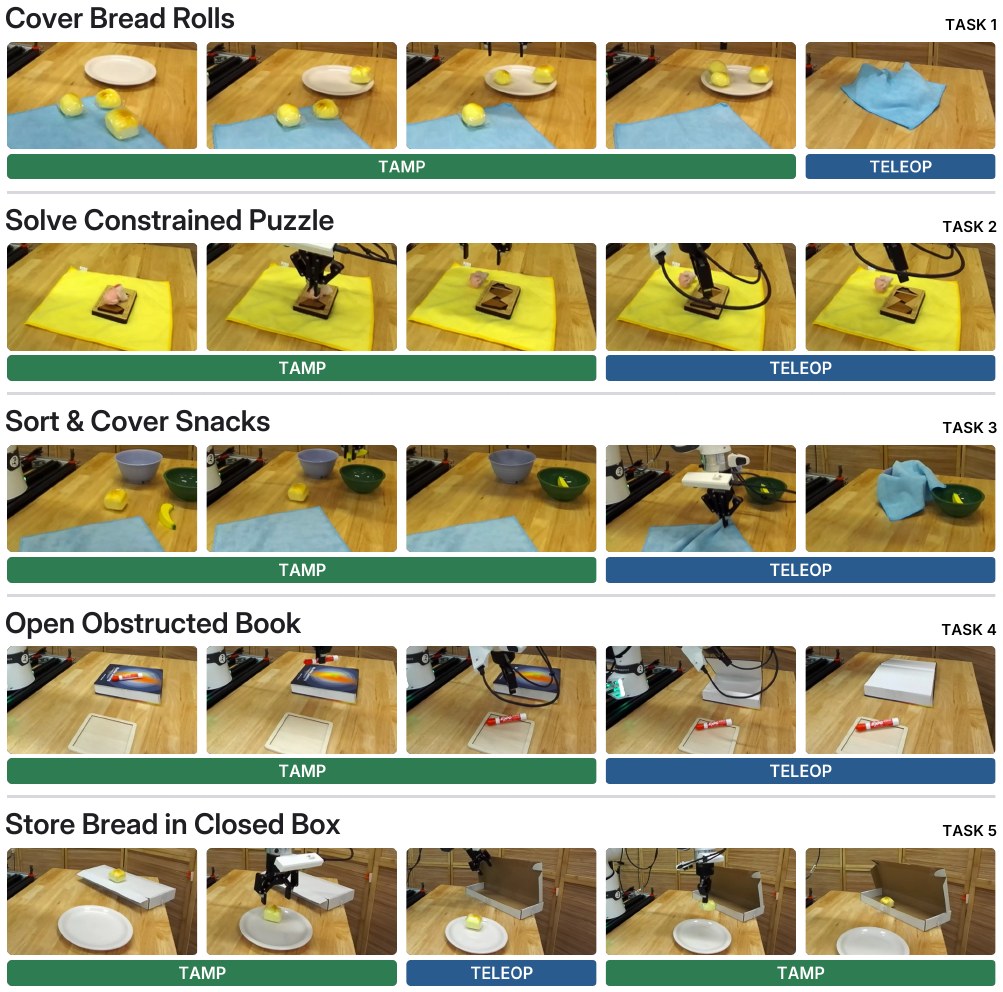
Five long-horizon tasks, each with at least one stage beyond the TAMP domain.
The label in each video shows who executes the current phase: TAMP or a human.
π0.5-DROID fine-tuned on 20 TANDEM demonstrations per task, compared with the pretrained model and HITL-TAMP (20 trials each).
| Task | π0.5-DROID | HITL-TAMP | TANDEM | |||
|---|---|---|---|---|---|---|
| Succ. | Prog. | Succ. | Prog. | Succ. | Prog. | |
| Cover Bread Rolls | 0% | 41.3% | 30% | 68.8% | 45% | 67.5% |
| Solve Constrained Puzzle | 0% | 30.0% | 0% | 30.0% | 50% | 65.0% |
| Sort & Cover Snacks | 0% | 31.7% | 15% | 68.3% | 75% | 85.0% |
| Open Obstructed Book | 0% | 38.3% | 30% | 71.7% | 50% | 76.7% |
| Store Bread in Closed Box | 0% | 33.3% | 10% | 40.0% | 80% | 93.3% |
| Average | 0% | 34.9% | 17.0% | 55.8% | 60.0% | 77.5% |
Success: every subgoal met. Progress: fraction of subgoals met.
The fine-tuned VLA executes each full task on its own, without TAMP or a human.
On Cover Bread Rolls, TANDEM and full-task teleoperation get the same human time.
Raw TAMP completes none of the five tasks. TANDEM collected 100 demonstrations from 130 attempts (76.9%).
93.3% of failures come from TAMP execution. The remaining 6.7% come from predicate/operator invention, all on Store Bread in Closed Box.
@article{tandem2026,
title = {TANDEM: Task and Motion Planning with As-Needed Demonstrations
for Efficient Vision-Language-Action Model Fine-tuning},
author = {Sahoo, Samrat and Ji, Liang and Silver, Tom and Huang, Yixuan},
year = {2026},
note = {Under review}
}