Each round shows two real-robot demonstrations of the same task. One was teleoperated by a person; the other was generated by DATAFARM. Pick the one generated by DATAFARM.
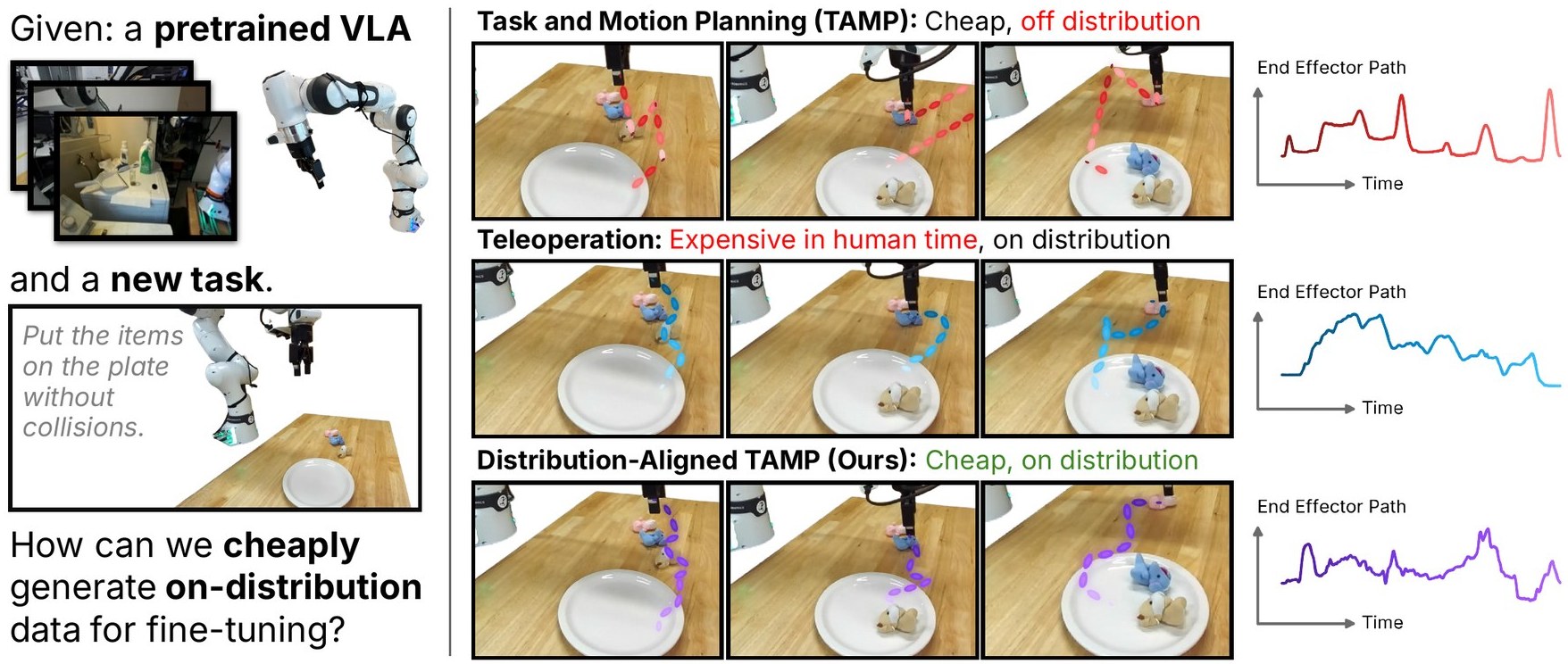
Collecting high-quality robot data remains a fundamental challenge for training robot foundation models. Task and motion planning (TAMP) offers a scalable way to generate demonstrations, but our experiments show that raw TAMP trajectories provide surprisingly little benefit when used to fine-tune pretrained vision-language-action (VLA) models, despite successfully solving the target tasks. We hypothesize that this failure arises from a behavioral distribution mismatch between planner-generated trajectories and the data used to pretrain the VLA.
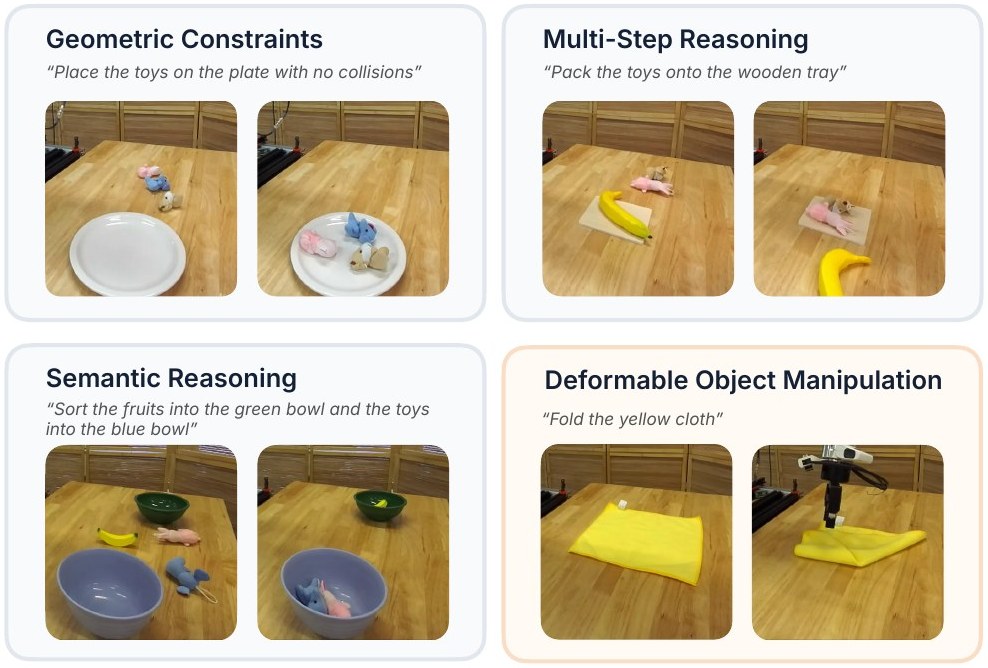
To address this mismatch, we introduce DATAFARM: Distribution-Aligned Task And motion planning for Fine-tuning A Robot foundation Model, an approach that incorporates the pretraining distribution directly into TAMP trajectory generation. DATAFARM aligns generated trajectories with the pretraining data in robot joint configurations, motion style, and temporal execution profiles. We evaluate DATAFARM on three tabletop manipulation tasks that TAMP can perform and a cloth-folding task beyond the capability of TAMP. DATAFARM achieves an average success rate of 56.7%, substantially outperforming raw TAMP (8.3%) while approaching human teleoperation (61.7%). On Deformable Object Manipulation, which is outside the fine-tuning distribution, the fine-tuned model retains 85% success, compared with 90% for the pretrained model. These results show that aligning planner-generated demonstrations with the pretraining distribution can make TAMP an effective source of data for VLA fine-tuning.
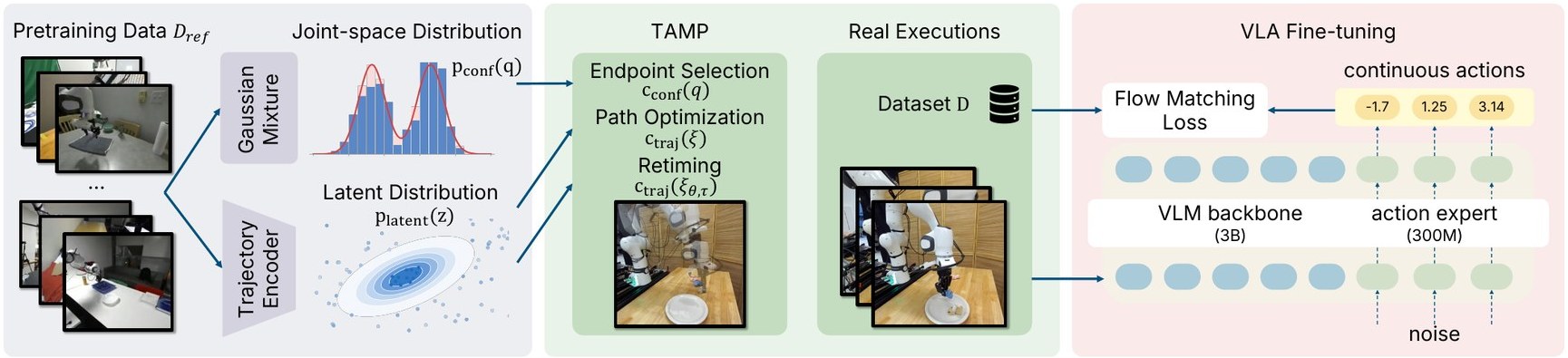
DATAFARM learns models of reference behavior from pretraining data and uses them to guide the planner’s configurations, paths, and timing.
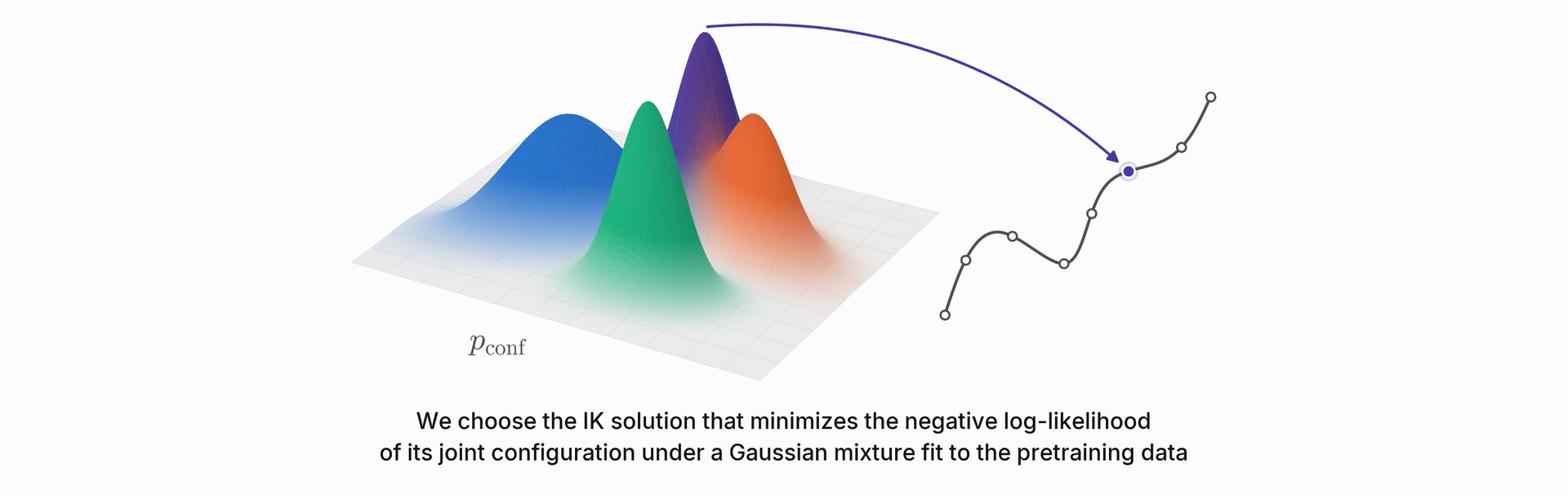
For each end-effector pose, rank the IK solutions by configuration cost, favoring arm postures with higher reference density.
Add the trajectory cost to the planner’s objective and optimize the waypoints by gradient through the frozen encoder. This changes how the arm moves between endpoints; feasibility is checked before acceptance.
Keep each path’s geometry fixed and optimize how quickly the robot traverses it, matching reference speeds around gripper events. Motion limits are checked before acceptance.
Each checkpoint is fine-tuned on 20 successful demonstrations and evaluated for 20 trials.
Both are successful planner executions; DATAFARM’s are aligned with DROID in joint configurations, motion style, and timing.
DATAFARM runs without human control; humans only set up and reset scenes.
Raw TAMP demonstrations solve the tasks yet barely help fine-tuning: a task-valid trajectory is not necessarily good fine-tuning data.
| Approach | Geometric Constraints | Multi-Step Reasoning | Semantic Reasoning | |||||||||
|---|---|---|---|---|---|---|---|---|---|---|---|---|
| Succ. | Prog. | OOD Succ. | OOD Prog. | Succ. | Prog. | OOD Succ. | OOD Prog. | Succ. | Prog. | OOD Succ. | OOD Prog. | |
| π0.5-DROID | 0% | 18% | 90% | 95% | 0% | 13% | 90% | 95% | 5% | 50% | 90% | 95% |
| Raw TAMP | 5% | 35% | 85% | 93% | 5% | 37% | 70% | 85% | 15% | 58% | 75% | 88% |
| DATAFARM w/o style | 10% | 39% | – | – | 0% | 31% | – | – | 35% | 54% | – | – |
| DATAFARM w/o timing | 0% | 19% | – | – | 0% | 18% | – | – | 0% | 29% | – | – |
| DATAFARM w/o joint space | 35% | 73% | – | – | 15% | 53% | – | – | 20% | 66% | – | – |
| DATAFARM | 65% | 84% | 80% | 90% | 35% | 81% | 85% | 88% | 70% | 89% | 90% | 93% |
| Human teleop (oracle) | 50% | 93% | 95% | 98% | 45% | 90% | 95% | 98% | 90% | 98% | 95% | 98% |
OOD: retention on Deformable Object Manipulation, which is excluded from fine-tuning. Teleoperation is an oracle only in its access to human demonstrations.
Each fine-tuned policy on its target task.
No fine-tuning dataset includes this task, yet the policies retain 85% average success.
Removing one component at a time lowers average success from 56.7% to 23.3% without joint space, 15.0% without style, and 0% without timing.
Cloth folding: 90% before fine-tuning; 80%, 85%, and 90% after fine-tuning on each target task.
Geometric Constraints; 0 is π0.5-DROID without fine-tuning. Success reaches 75% at 40 demonstrations and 85% at 80.
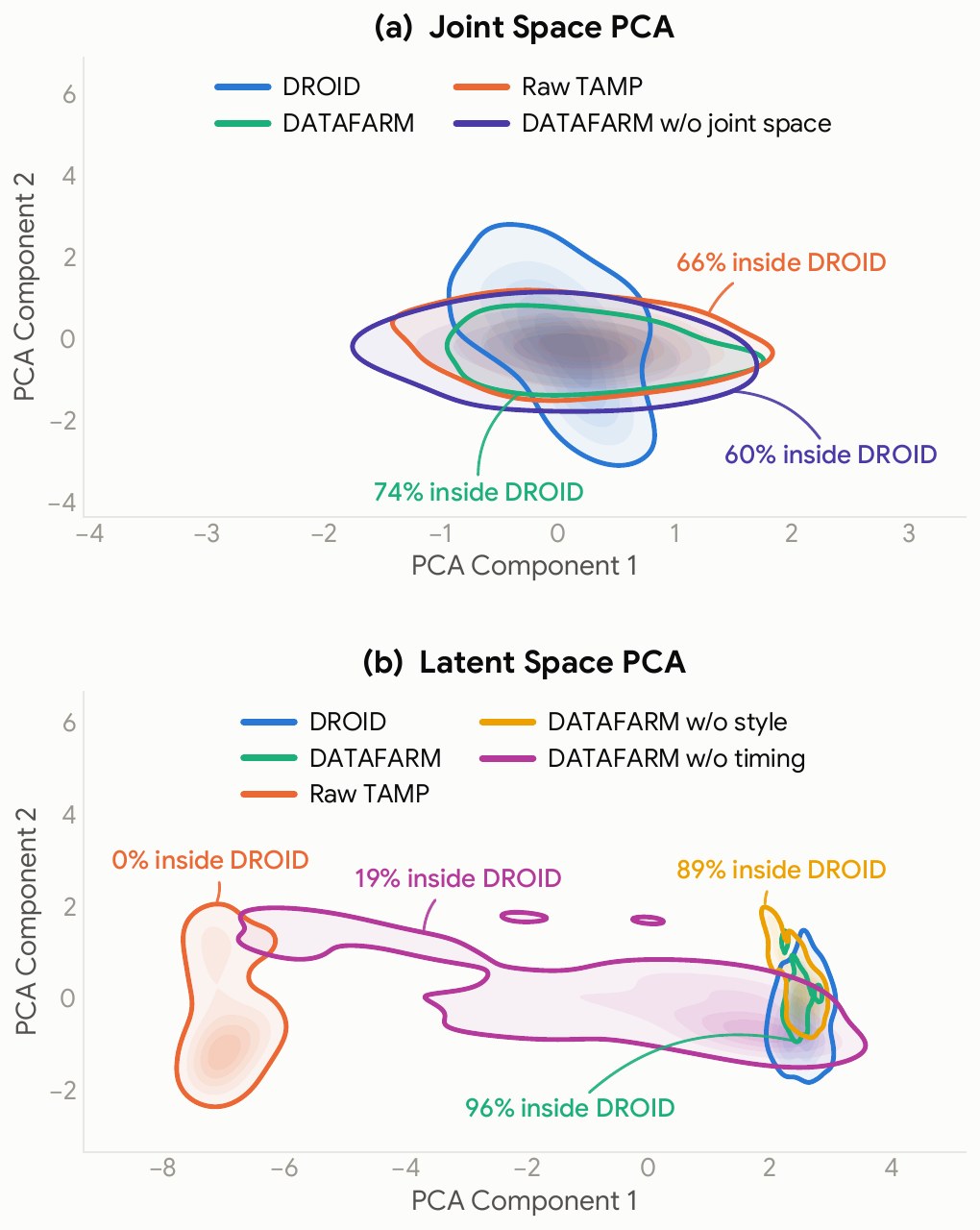
Samples projected onto the first two principal components of (a) joint configurations and (b) trajectory embeddings.
Joint space: 74% of DATAFARM samples lie inside the DROID contour, vs. 66% for raw TAMP and 60% without joint-space alignment.
Trajectory latent space: 96% for DATAFARM, vs. 0% for raw TAMP, 89% without style, and 19% without timing.
Overlap alone does not ensure success: the style ablation reaches 89% overlap but only 15.0% success.
Using TAMP, the robot can alternate between collecting a demonstration and resetting the scene.
Nine rollouts and eight resets in 14 minutes.
@article{datafarm2026,
title = {DATAFARM: Distribution-Aligned Task and Motion Planning
for Fine-Tuning Vision-Language-Action Models},
author = {Sahoo, Samrat and Huang, Yixuan and Silver, Tom},
year = {2026},
note = {Under review}
}